
Work is a four-part silver sculpture made with Asprey Studio in 2024 and co-produced by Martin Klipp of Beyond Art Creative. It began as a digital sequence.
The subject is labor, and what happens to it when most of the effort in a working day comes down to a click. The body still does something. It just does very little, and the result shows up somewhere else.
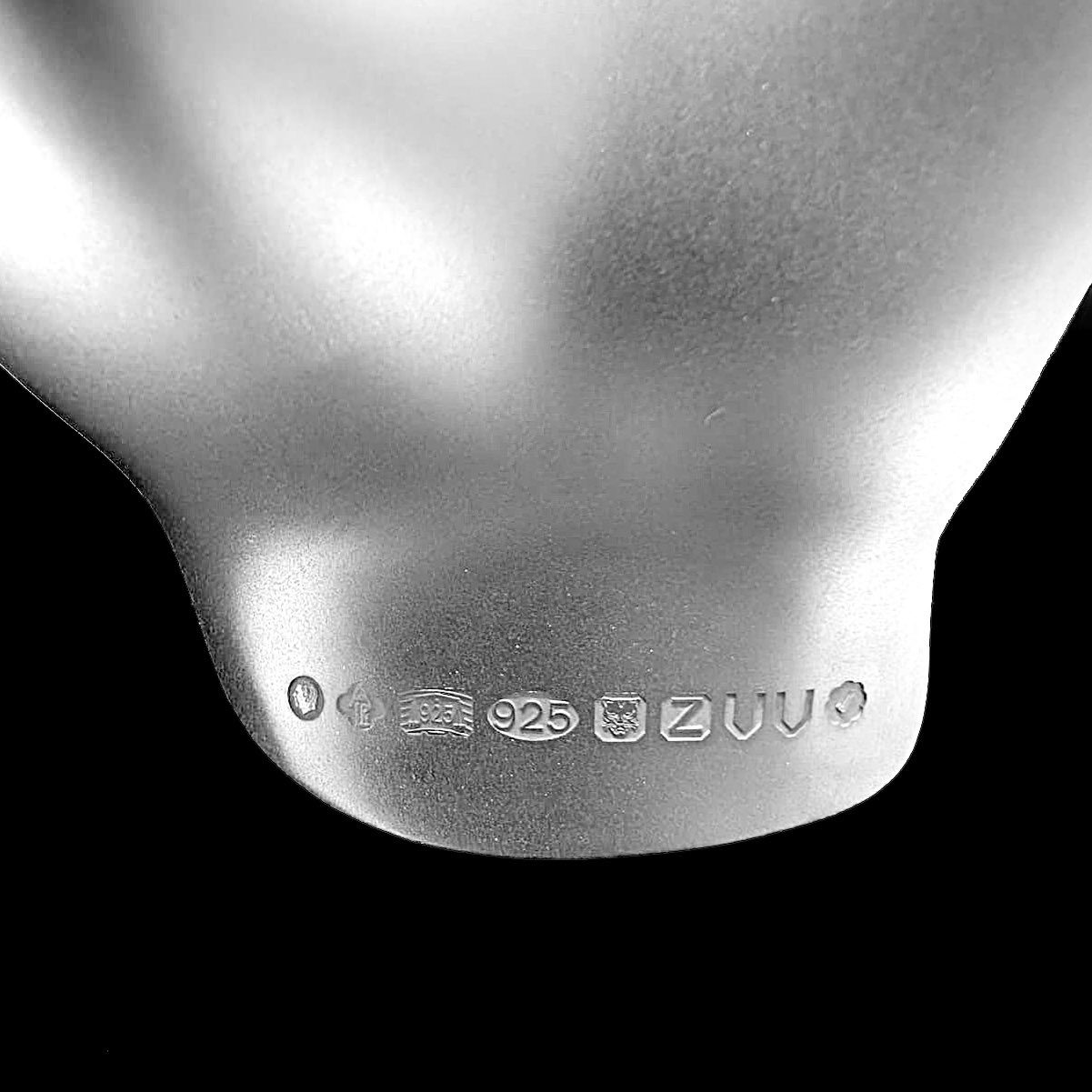
Four hands stand in a row. The first is a realistic human hand and carries two hallmarks the Assay Office granted to the artist for this work. Each hand after it loses detail, until the last is the stepped, pixelated pointer of a computer cursor. Cast in silver, the cursor has weight and a hallmark, two things it never has on screen.
The pointing hand is one of the oldest gestures in Western art, from the near-touch of Michelangelo's Creation of Adam to the manicule printers used to mark a passage. The cursor is that hand reduced to an icon. Work runs the reduction backwards in a precious metal, the way a goldsmith would treat a relic. It also answers Andy Warhol, who wanted to be a machine, by showing what the machine took in exchange.
Which of the four hands did the work?
From hand to cursor
The sequence began as a digital work. Asprey's account describes the sculpture as a way of making changes in labor visible: the body's effort gives way to a small action at an interface.1
Making and marking
Asprey Studio made the sculpture by hand in silver. It took two years to develop and more than six months to make. Martin Klipp of Beyond Art Creative co-produced it.
The Assay Office granted two official hallmarks to the artist for it. The first hand carries them, so a 750-year-old ledger of precious metal sits on the same object as a token on Ethereum.
The marks bring a material system of verification into a work concerned with digital abstraction. They establish a different kind of evidence from the cursor's visual suggestion of action.1,2,3
What the viewer encounters
The sculpture does not require its owner to burn, combine or vote. The sequence itself establishes the comparison. Moving it from an image into silver makes the relation between physical effort and apparently effortless action tangible.
Work later appeared with Luck and Play in Silk's Art Basel Hong Kong presentation. The participatory rules of that larger presentation should be distinguished from the four-part sculpture.2
Development
Hallmarks
Images


Notes on the record
- This interpretation comes from the work's production partner.1
Sources and further reading
Artist statements describe intention. Reporting and interviews record different perspectives; exhibition announcements establish specific presentations. How sources are classified.
1. Gallery / platform · Production-partner documentation
Asprey Studio × Jack Butcher
Documents the silver Work sculpture and its assay marks. Asprey is the fabricator and a project partner, not an independent critic.
2. Exhibition record · Exhibitor project record
Jack Butcher: Work, Luck, Play
Documents the Hong Kong presentation, 25-29 March 2026, and production credits. Silk describes its own involvement in production, collecting and the surrounding editorial programme.
3. Artist / studio · Post on X
Work: two hallmarks from the Assay Office
States that the Assay Office granted two official hallmarks to the artist for the first time, that Asprey Studio made the piece by hand, two years in development and over six months to make, co-produced with Martin Klipp of Beyond Art Creative.