Notes /
Work
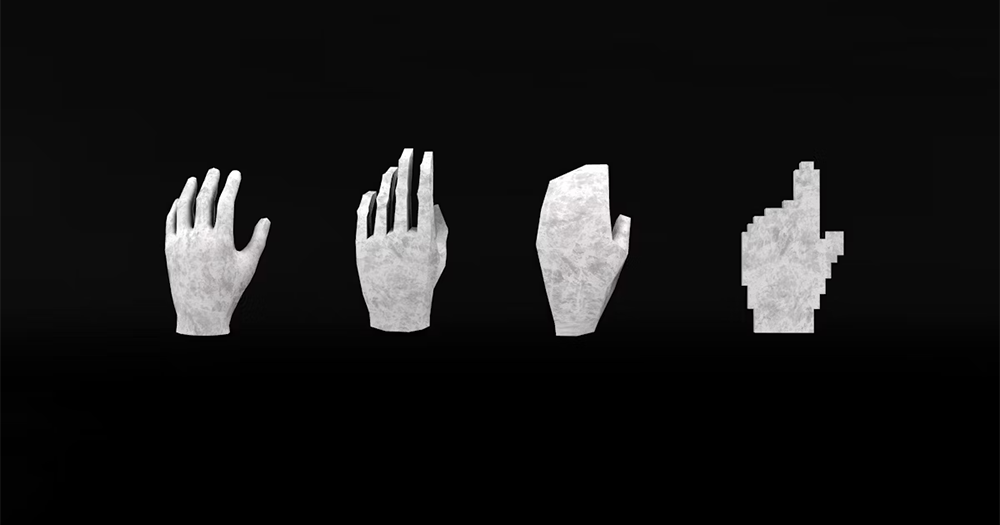
Work is four hands in a row, cast in silver. The first one is a realistic human hand. Each one after it loses detail, until the last is the stepped, pixelated pointer you move around a screen all day. Asprey Studio made it by hand. It took two years to develop and more than six months to make, and Martin Klipp of Beyond Art Creative co-produced it. It started as a digital sequence.
The question behind it is simple. Most of the effort in a working day now comes down to a click. The body still does something. It just does very little, and the result shows up somewhere else.
Hannah Arendt drew the lines I keep coming back to in The Human Condition, published in 1958. She splits the active life into three activities. Labor is tied to staying alive. Work is tied to making a world. Action is what people do in front of each other.
The split between the first two is the one that matters here. As the Stanford Encyclopedia puts it, labor is judged by its ability to sustain life and cater to consumption. Work is judged by its ability to build and maintain a world fit for human use. Labor gets eaten. Work stays. A table outlasts the afternoon it took to make it.
Her account of the modern age is that labor won. The figure she calls animal laborans beat homo faber, the maker. The values of fabrication, permanence, stability and durability, gave way to life, productivity and abundance.
A cursor is a strange case. Nothing about a click is durable. It is gone before you notice you did it. But a lot of what gets built now gets built through it. The hand that made things and the hand that consumes things have collapsed into the same small arrow, and on screen you cannot tell which one you are looking at.
So I went the other way. I took the pointer and gave it the most durable treatment I could think of. Silver, made by a goldsmith's process, slow on purpose. On screen the cursor weighs nothing. Here it has weight.
It also has a hallmark. The first hand carries two official hallmarks the Assay Office granted for this work. That is a 750 year old ledger of precious metal sitting on the same object as a token on Ethereum. Two systems for proving something is what it says it is.
Arendt was worried that labor would swallow work. I am not sure she was wrong. I was curious what happens if you force the click back into the category of a made thing and keep it there.
Work was shown with Luck and Play in Silk's presentation at Art Basel Hong Kong, 25 to 29 March 2026.
Work: Work