Notes /
Stock
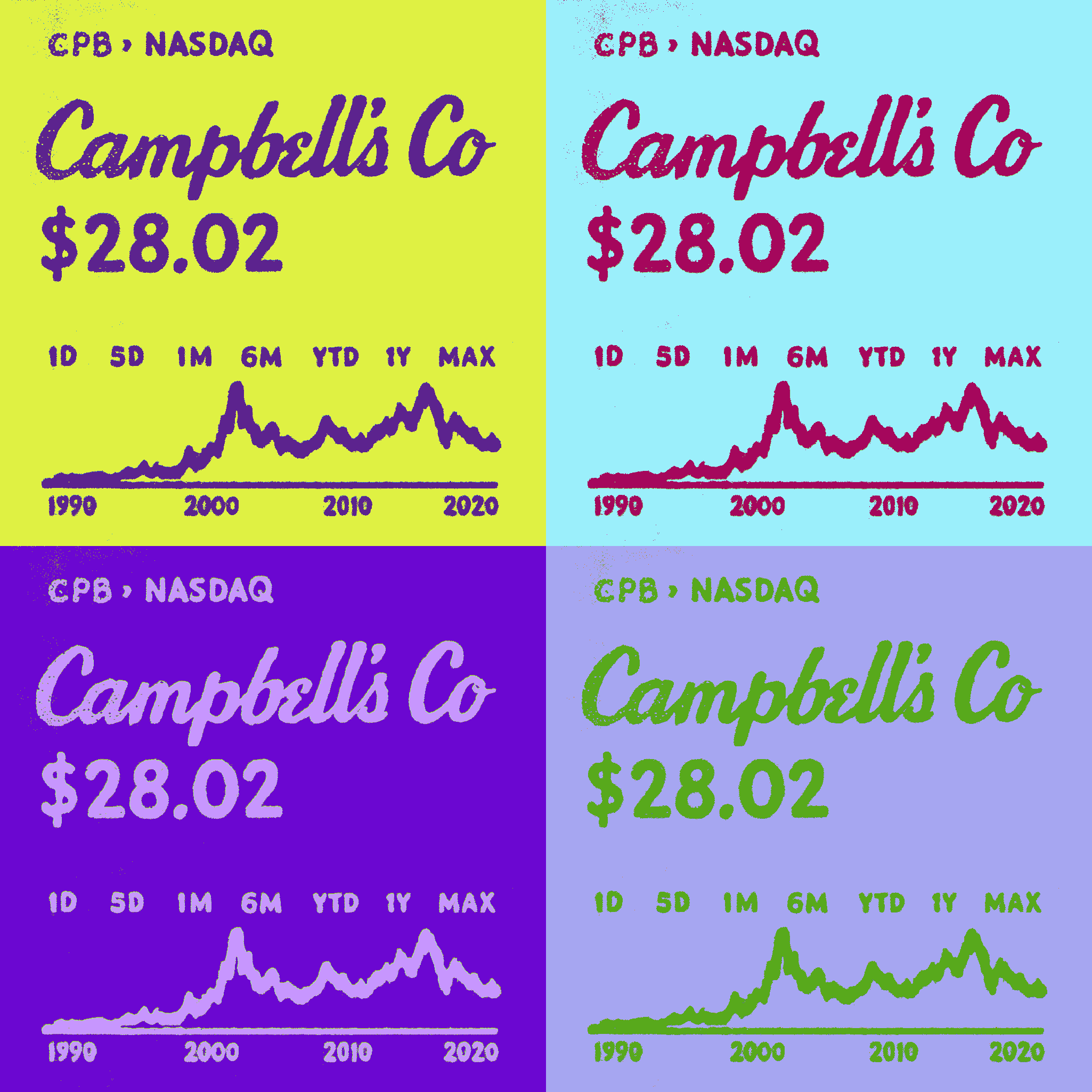
Stock is a generative edition of 150 works from 2025. The subject is Campbell's. Where the red and white label used to be, every work carries a market chart, and the quote of $28.02 is fixed in the image.
The obvious reference is Warhol. In 1962 he showed 32 hand-painted canvases of Campbell's Soup Cans, one for each flavor, and turned a supermarket product into a painting. Sixty years later most people meet the same company less as a can in a cupboard and more as a symbol on a screen. So I kept the brand and swapped the package for the price.
The text I had in mind is older than Warhol. Chapter one of Marx's Capital opens with the commodity, and section four starts like this: "A commodity appears, at first sight, a very trivial thing, and easily understood. Its analysis shows that it is, in reality, a very queer thing, abounding in metaphysical subtleties and theological niceties."
A can of soup is about as trivial as a thing gets. Marx's point is that the strangeness isn't in the soup. "So far as it is a value in use, there is nothing mysterious about it." The mystery starts when the thing gets a price, because the price is a relation between people that shows up looking like a property of the object. He calls it "a definite social relation between men, that assumes, in their eyes, the fantastic form of a relation between things."
Then there is the line that made me want to write this note. "Value, therefore, does not stalk about with a label describing what it is. It is value, rather, that converts every product into a social hieroglyphic." Warhol painted the label. Stock takes the label off and puts the value where it was. The chart is the thing Marx said you would never see printed on the object, and here it is printed on the object.
He also has the commodities talk. "Could commodities themselves speak, they would say: Our use value may be a thing that interests men. It is no part of us as objects. What, however, does belong to us as objects, is our value." That is a fair description of a ticker. Nobody eats a share price.
The variations follow the same logic. The edition runs through several visual systems, and the ones kept on the site are Halftone, Interlaced, Noise, Gradient and Outlined. Warhol's repetition was about mass production, the same can rolling off the same line. These are the same subject passed through different printing and screen effects, the number of ways one market can be rendered.
One more detail matters to me. The chart in the work is not a live feed. It doesn't move, and a holder can't change it. Owning one gives you no share in the company. It is a picture of a price that is itself a picture of a relation, and the work is a token with a market of its own on top of that. Marx was writing about coats and linen. I don't think he expected the hieroglyphic to be collected.
Work: Stock