Notes /
Lemonade Stand
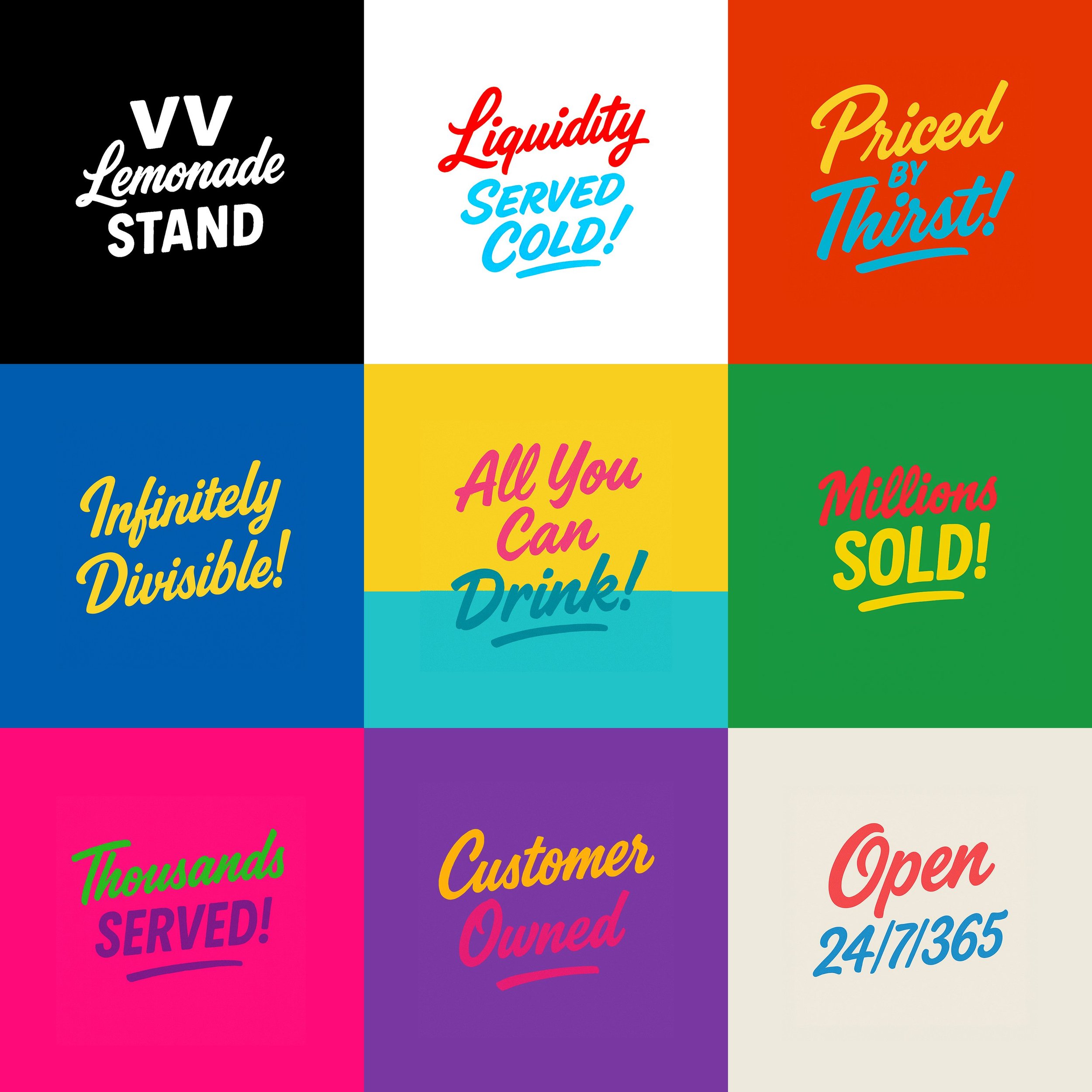
Lemonade Stand started by accident. On 27 July 2025 a Zora creator coin switched on when I logged into the iOS app. I wrote at the time that it was "a bit mental" and that I would have liked to do something like it much more intentionally. Two days later I posted a grid of nine tiles and called it Lemonade Stand.
The idea was simple. The lemonade stand is the first lesson most of us get in buying and selling. So the market that turned itself on became the subject. Nine images, each one tied to its own coin, dressed up as posters for a brand. Liquidity Served Cold. Priced by Thirst. Infinitely Divisible. Customer Owned. Open 24/7/365.
The text I keep coming back to is chapter 12 of Keynes's General Theory, the one on long-term expectation. It was published in 1936 and it describes this project almost line for line.
Keynes says the private object of most skilled investment is "to beat the gun," "to outwit the crowd, and to pass the bad, or depreciating, half-crown to the other fellow." Then he calls it a game. "A game of Snap, of Old Maid, of Musical Chairs." He adds that "these games can be played with zest and enjoyment, though all the players know that it is the Old Maid which is circulating."
That is the part that interests me. Everyone knows. Nobody is fooled. The game still runs.
Then he gets to the beauty contest. Competitors pick the six prettiest faces from a hundred photographs, and the prize goes to whoever comes closest to the average choice. So you don't pick the faces you like. You pick the ones you think everyone else will pick. Keynes calls that the third degree, "where we devote our intelligences to anticipating what average opinion expects the average opinion to be." He thinks some people practise the fourth and fifth.
Lemonade Stand is nine faces in that contest. Each picture can be looked at on its own, and its coin can trade at the same time. The trading changes nothing about what you see. The poster that says Millions Sold looks exactly the same whether it has sold millions or none.
Keynes is also hard on liquidity. He calls the fetish of liquidity the most anti-social maxim of orthodox finance and says "there is no such thing as liquidity of investment for the community as a whole." I put Liquidity Served Cold on the second tile. The original copy for the project linked large supplies to guaranteed liquidity. The catalogue has since dropped that line, because having units doesn't mean anyone will buy them.
The posts I wrote on launch day said it more briefly. "price is not value, value is not price." A few weeks later I started sketching a simulator, a stand that grows "from driveway to gigacorp," with the price of lemons pulled from the token. It was meant to satirize p/e ratios. My note for the whole thing was "permissionless capitalism and nonsensical fundamentals."
Keynes worried about the moment "enterprise becomes the bubble on a whirlpool of speculation." A lemonade stand is the smallest enterprise there is. Here the stand is the bubble, and it says so on the sign.
Work: Lemonade Stand