Notes /
Know Your Collector
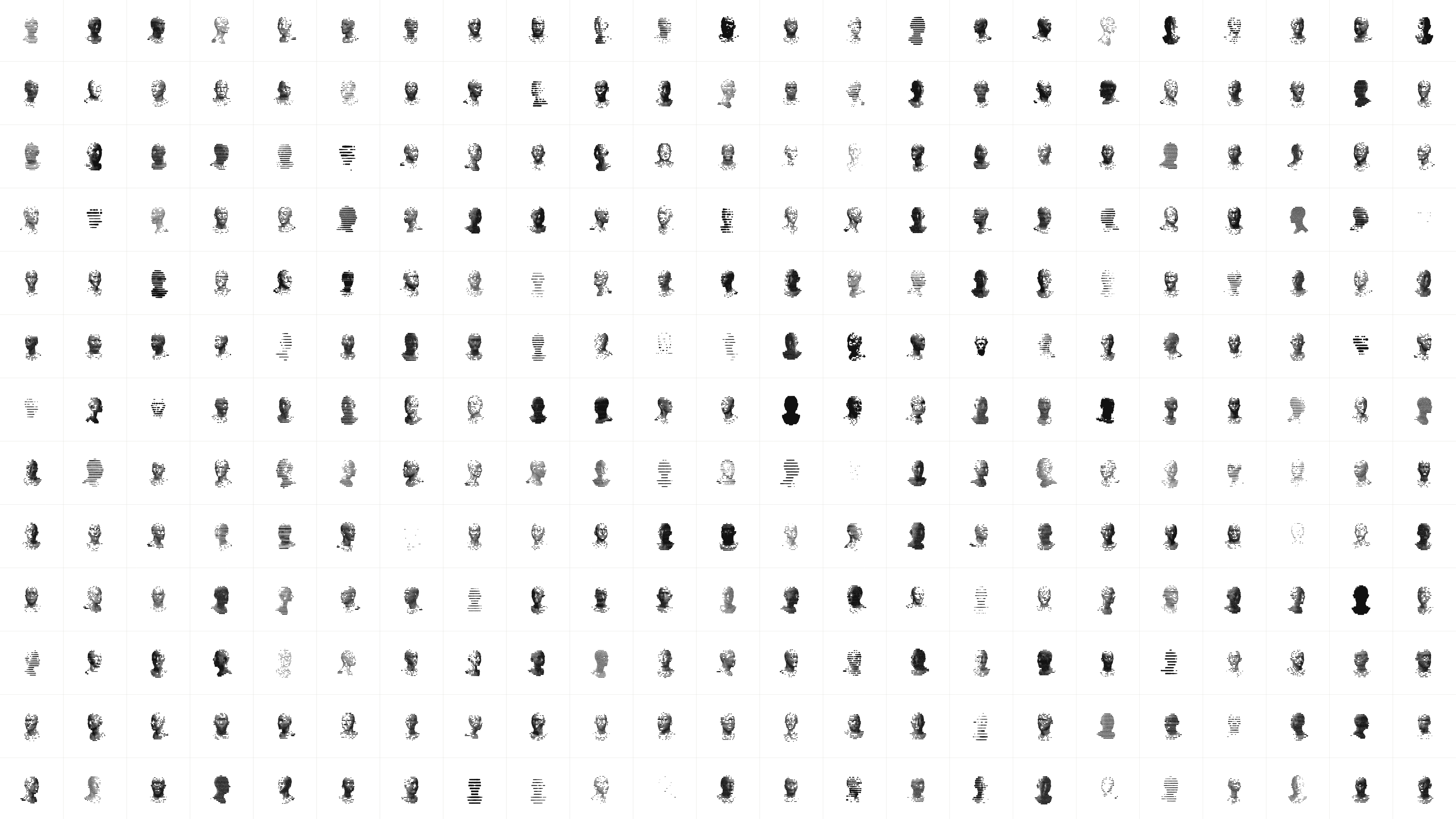
Know Your Collector is 565 portraits of people who don't exist. Every one starts as a synthetic head from Google's GNM Head model. A seed picks an identity that belongs to nobody. Separate settings control the pose, the expression, the lighting and the horizontal bands that draw the face.
Collectors did the rest. Access came through a patron edition. Each person adjusted a face until it was the one they wanted, saved a single version, and posted a public code from their X account to claim it. What's left is an image and a saved set of instructions, tied in public to an account.
The title comes from banking. Know your customer is the rule that makes you hand over your real face and your real documents before you're let in. Here it runs backwards. The face is invented. The only thing that gets verified is the choice.
Joanna Zylinska's The Perception Machine starts from a plain observation. "We are constantly photographing and being photographed, with imaging machines large and small capturing our every move." The book is about what happens when those pictures become training data and come back out as new pictures. She points to websites such as This Person Does Not Exist, which "generated realistic-looking photographic images of people of various ages, genders, and races." That is the raw material here. A face with no owner.
The line I keep coming back to is about who we are inside these systems. Zylinska writes that the citizen's "primary yet already dual identity in this system is that of both network users and data points." Know Your Collector makes that split literal. The account is the user. The portrait is the data point. The record links the two and says nothing about whether they look alike.
She also quotes Vilém Flusser on people "attempting to create a space for human intention in a world dominated by apparatuses." His next sentence is the catch. "However, the apparatuses themselves automatically assimilate these attempts at liberation and enrich their programs with them." Every setting a collector moved was a decision the model had already allowed for. The intention is real, but it is expressed in the machine's terms.
The model's full name is the Generative aNthropometric Model. Anthropometry is the old practice of measuring bodies in order to classify people. Zylinska spends time with The Recognition Machine by Antje Van Wichelen and SICV, a photo booth that runs your picture against a database of nineteenth century anthropometric photographs and links surveillance now to the surveillance of a colonial past.
Know Your Collector uses the same kind of measurement and points it somewhere else. Nobody is being identified. Someone is choosing a face to be identified by.
The saved export from 19 August 2026 holds 565 of those choices.
Work: Know Your Collector