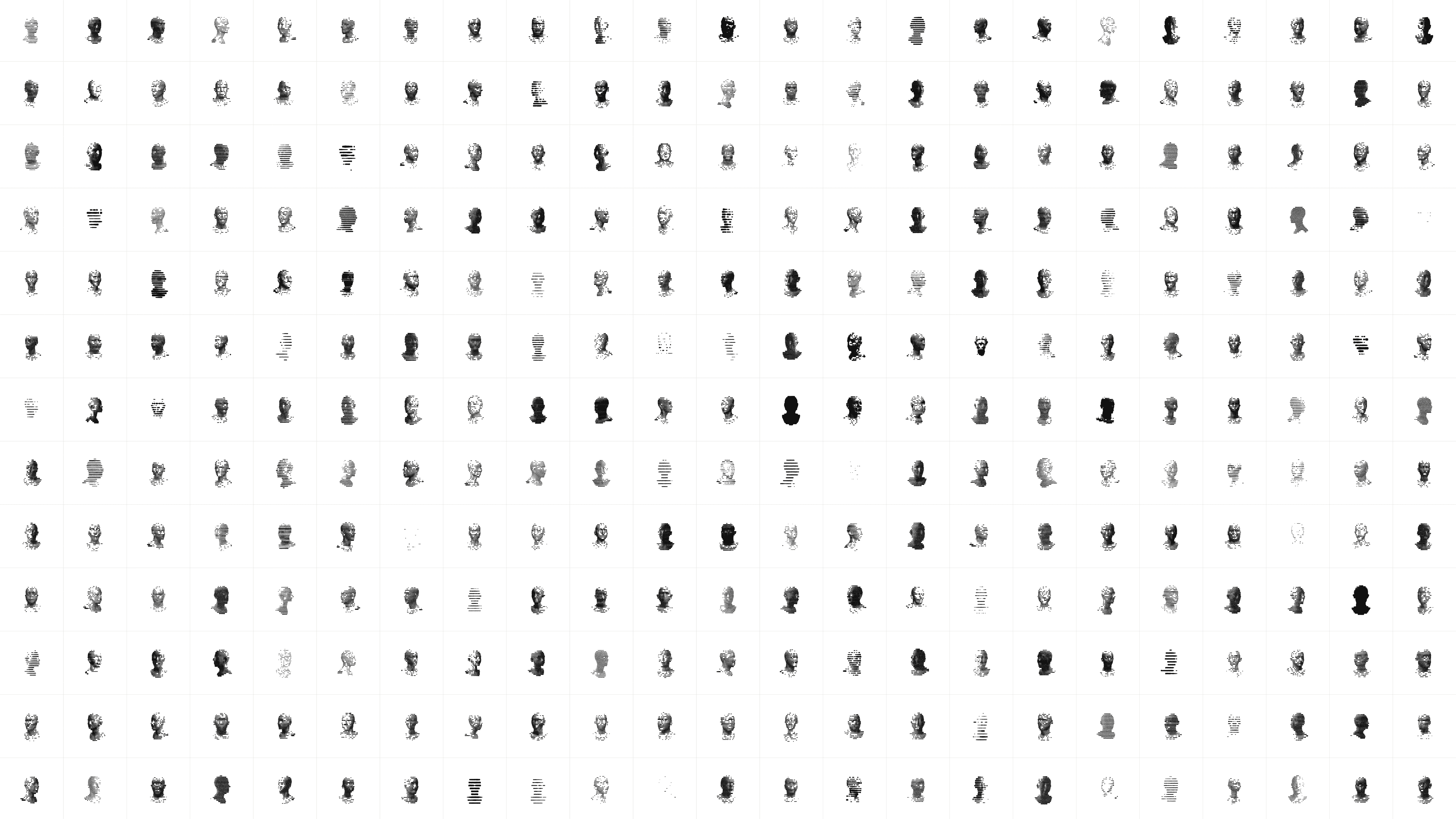
Know Your Collector, from 2026, is a collection of 565 synthetic portraits, each shaped and chosen by a participant.
The title turns a bank's demand around. Here the face is invented, and what is verified is the decision to claim it.
Every portrait starts as a synthetic head from Google's GNM Head model. A participant adjusted pose, expression, lighting and the horizontal bands that draw the face, then saved one version and posted a public code from their X account. The result is an image and a saved set of instructions. It looks like a person who does not exist, linked publicly to someone who does.
In the 1980s Nancy Burson used early computer software to merge many faces into one composite portrait of nobody. Cindy Sherman built a career photographing herself as people she was not. Know Your Collector puts the construction in the collector's hands. The face is a choice, and the choice is the only real thing in the record.
What does it mean to verify someone with a face that was never theirs?
How a portrait is made
The renderer uses Google's GNM Head model. A seed selects a synthetic identity; separate settings control pose, expression, lighting and the horizontal bands that describe the face. The project's attribution notice identifies the model components used and their license.
This distinction matters: changing the treatment can leave the underlying identity recognizable. The resulting portrait is both an image and a saved set of instructions.2,3
What a collector chose
The studio's procedure required access through a patron edition, selection of one configuration and a public verification code posted from an established X account. That procedure linked an account to a choice. It did not establish that the generated face resembled its holder.
The final collection lets a reader examine saved configurations and different renderings.1,4
Identity as an association
The title reverses an institutional demand to identify a customer. Here the recognizable face is constructed, while the decision to choose it belongs to a participant. In this reading, the internet is the medium of that public association; synthetic appearance and verified choice remain different kinds of evidence.
Development
The saved collection export records 565 configurations. Source
Notes on the record
Sources and further reading
Artist statements describe intention. Reporting and interviews record different perspectives; exhibition announcements establish specific presentations. How sources are classified.
1. Artist / studio · Preserved primary-source excerpts
Know Your Collector: Preserved studio catalogue excerpts
Selected passages from the public catalogue before this editorial revision. These preserve the artist's account; their inclusion is not independent corroboration. The capture date is not the work's creation date.
2. Artist / studio · Implementation attribution
KYC: GNM attribution notice
Identifies the GNM components incorporated in the renderer and their Apache 2.0 license.
3. Technical reference · Model documentation and source
GNM: Generative aNthropometric Model and Ecosystem
Describes the parametric head model. Use in KYC is recorded separately in the project's attribution notice; this is not a claim of an artistic collaboration or endorsement by Google.
4. Artist / studio · Interactive collection and saved configuration record
KYC: Saved collection
Uses the repository's saved export generated 19 August 2026, containing 565 records. Export date is not a launch date; collection count is not a current-owner count.