Notes /
Hardware
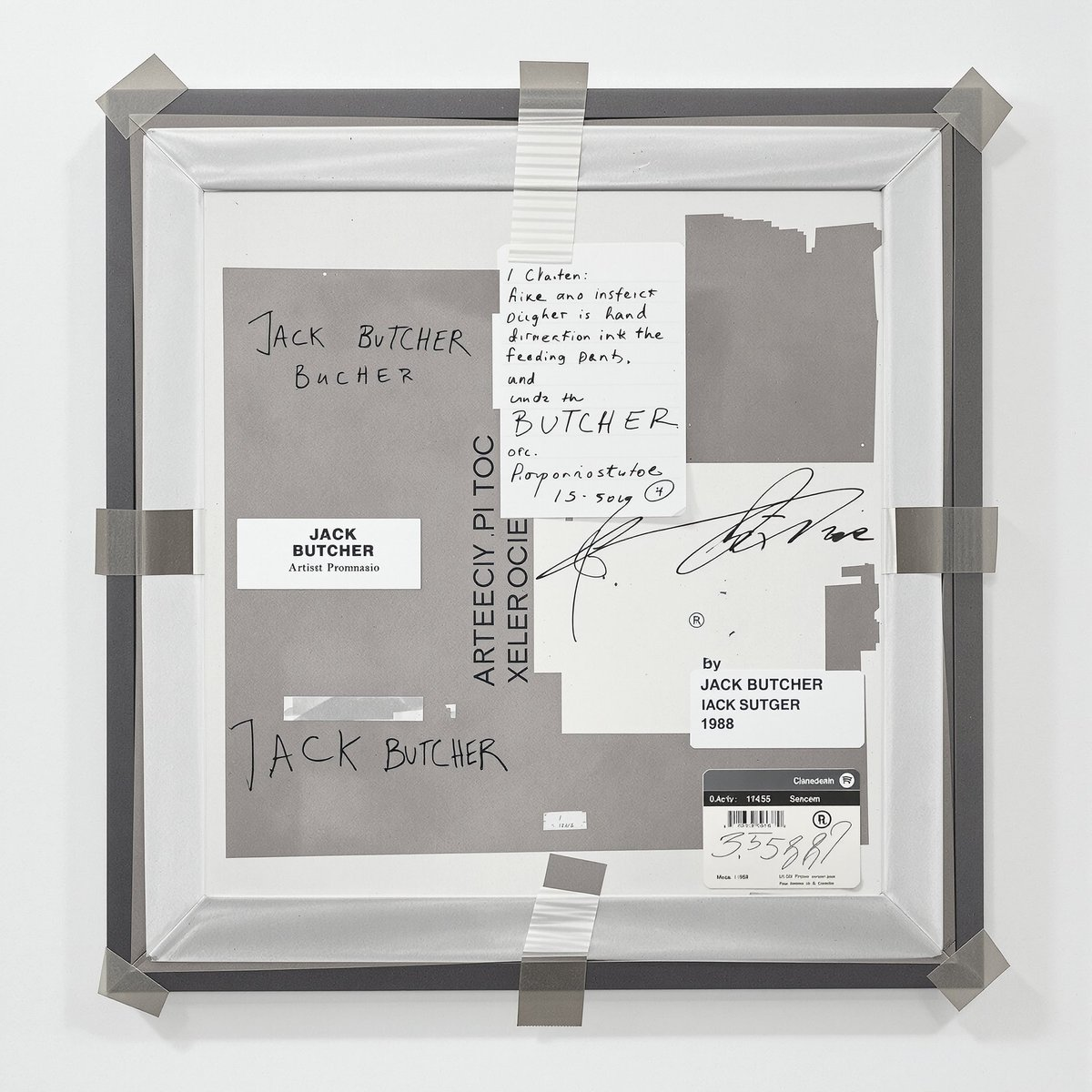
Hardware is 544 pictures of the stuff that usually sits around a work: a frame, a mount, a label that looks institutional, a handwritten mark. None of it is real. I generated about 10,000 images with Flux and kept 544. The paperwork is part of the picture, and no institution issued any of it.
It went out on 1 January 2025 with Highlight. Holders of an earlier piece, 1988, could exchange it for Hardware on Ethereum mainnet. I announced the supply as 554 and corrected it to 544 later that day. Each piece carries two records that do different jobs. The token says who owns it. The label inside the image vouches for a work that is not there.
I wrote at the time that Hardware "exposes the fragility of physical authenticity systems by turning their visual cues into deliberate fictions." Provenance is supposed to establish history. A lot of the time it is just a story told with props that look official.
That is why I keep coming back to Rachel Haidu's The Absence of Work, her book on Marcel Broodthaers from 1964 to 1976.
Haidu argues that all of Broodthaers's art is defined by its relationship to language. After years as a poet, he accepted what she calls his poetry's "failure to communicate," and turned instead to noncommunicative, nontransparent uses of words. Labels, captions, declarations. Language that does not explain an object so much as stage the authority that would certify one.
In 1968 Broodthaers opened a museum of his own invention, the Musée d'Art Moderne, Département des Aigles. Shipping crates, postcards, labels. It had the look of a museum and nothing else. Haidu reads that practice as an analysis of how institutions erect authority through language, including the sign that claims to stand in for a missing origin.
Hardware sits in that line without copying it. The frame and the label are the work. There is no painting behind them to authenticate. The token is a real ownership record on a chain. The invented certificate inside the image is a picture of the language people use to trust objects. Put them next to each other and the gap shows.
Selection matters as much as the fiction. A model produces variations. I decide which 544 belong. The apparently handwritten marks are generated. The institutional-looking labels are generated. What you are looking at is the apparatus of authentication with the authenticated thing left out.
Work: Hardware