Notes /
Economy of Words
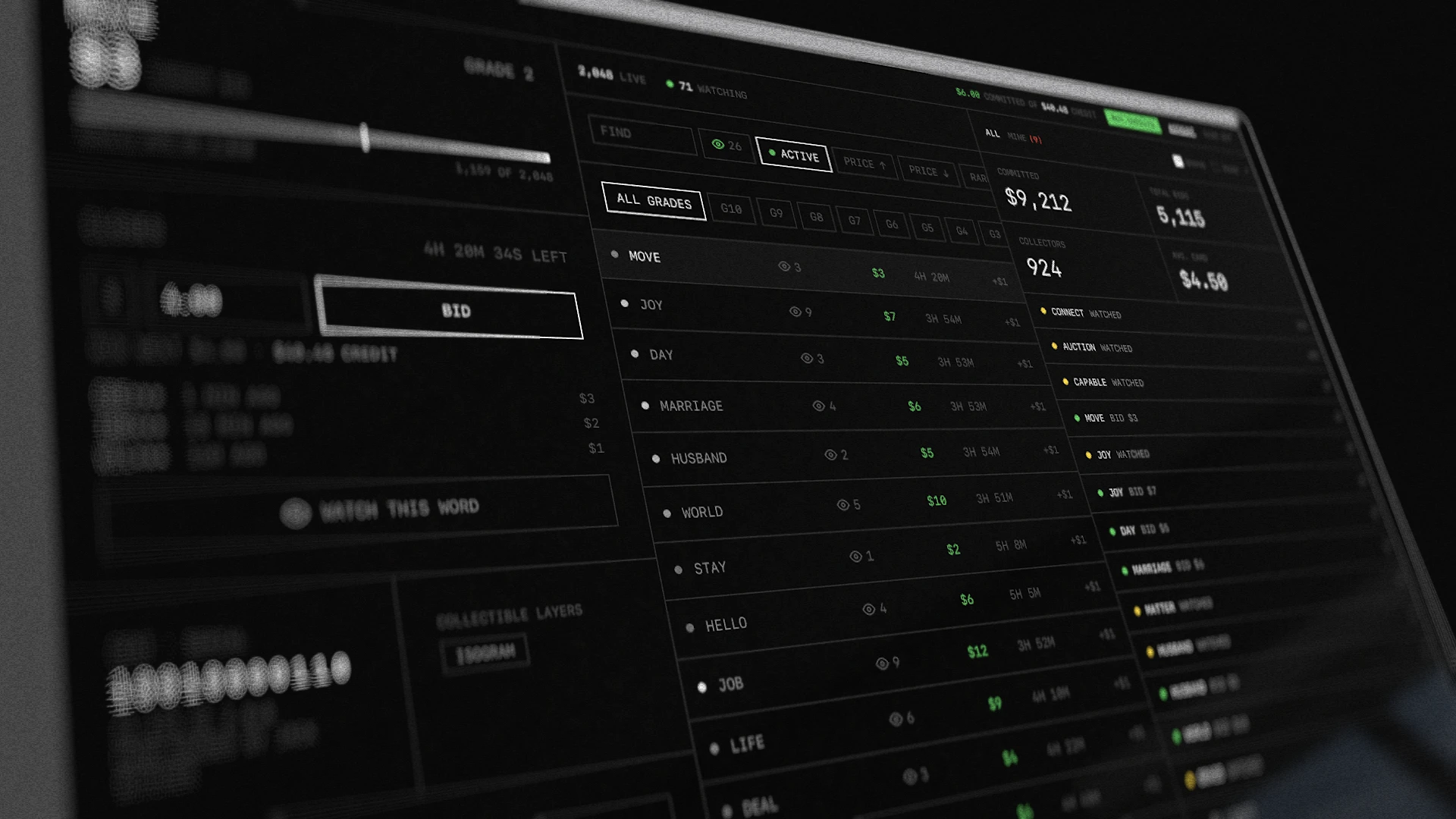
The English BIP39 list has 2,048 words. It exists so a person can write down the recovery phrase for a crypto wallet. Nobody picked those words for what they mean. They were picked so a machine could turn them into keys and a person could copy them onto paper without mistakes.
Economy of Words gives each of those words a hand-drawn card in a graded case. A rule scores every word on its length, its first letter, its letter values and its place in the list, and sorts it into one of ten bands. Each card went to auction at $1 for 20 hours and 48 minutes. The winner then had 2,048 minutes to choose the physical card or a synthetic one on Ethereum, and that choice locked.
Liz Kotz wrote Words to Be Looked At about language in art made in and around New York between 1958 and 1968. The title comes from Robert Smithson, who described a 1967 show at the Dwan Gallery as "Language to be Looked at and/or Things to be Read." In many of the works she studies, words are reduced to an object nearly emptied of meaning. Her bookends are the text score for Cage's 4'33" and Warhol's a: a novel, twenty-four hours of talk taped and transcribed.
The part of her argument I keep coming back to is the cause. She says the turn to language in that decade was a reaction to new recording and transmission media. Words took on a new materiality once magnetic tape and video arrived. Language became something you could handle, store and play back.
The BIP39 list is the extreme case of that. It is language already emptied out by design. A word on that list does not carry an opinion or a statement. It carries a number. A run of them in the right order can restore a whole wallet. One of them on its own holds nothing. I wanted to see what happens when you take one word out of the sequence and hand it back to a person.
What happens is that people bring their own reasons. The grade is the system's opinion. It is a rule, not a judgment of the drawing. The bids are the public's opinion. The two rarely agreed, and that gap was the point. A bidder can want a word for reasons the score was never built to see.
Kotz notices that the 1960s artists lived through social upheaval and still used words without making statements with them. These words never had statements to make. The only thing added was a market, and then wear. Synthetic cards degrade with every trade. Fewer than three sales and a card stays mint. When condition went live on 10 July 2026, one card had traded four times. It was REGRET.
Smithson's line splits language into things to look at and things to read. A seed word is a third thing. It is meant to be copied and never looked at, and here it is in a case, under a grade, being looked at.
Work: Economy of Words