Notes /
Wrappers
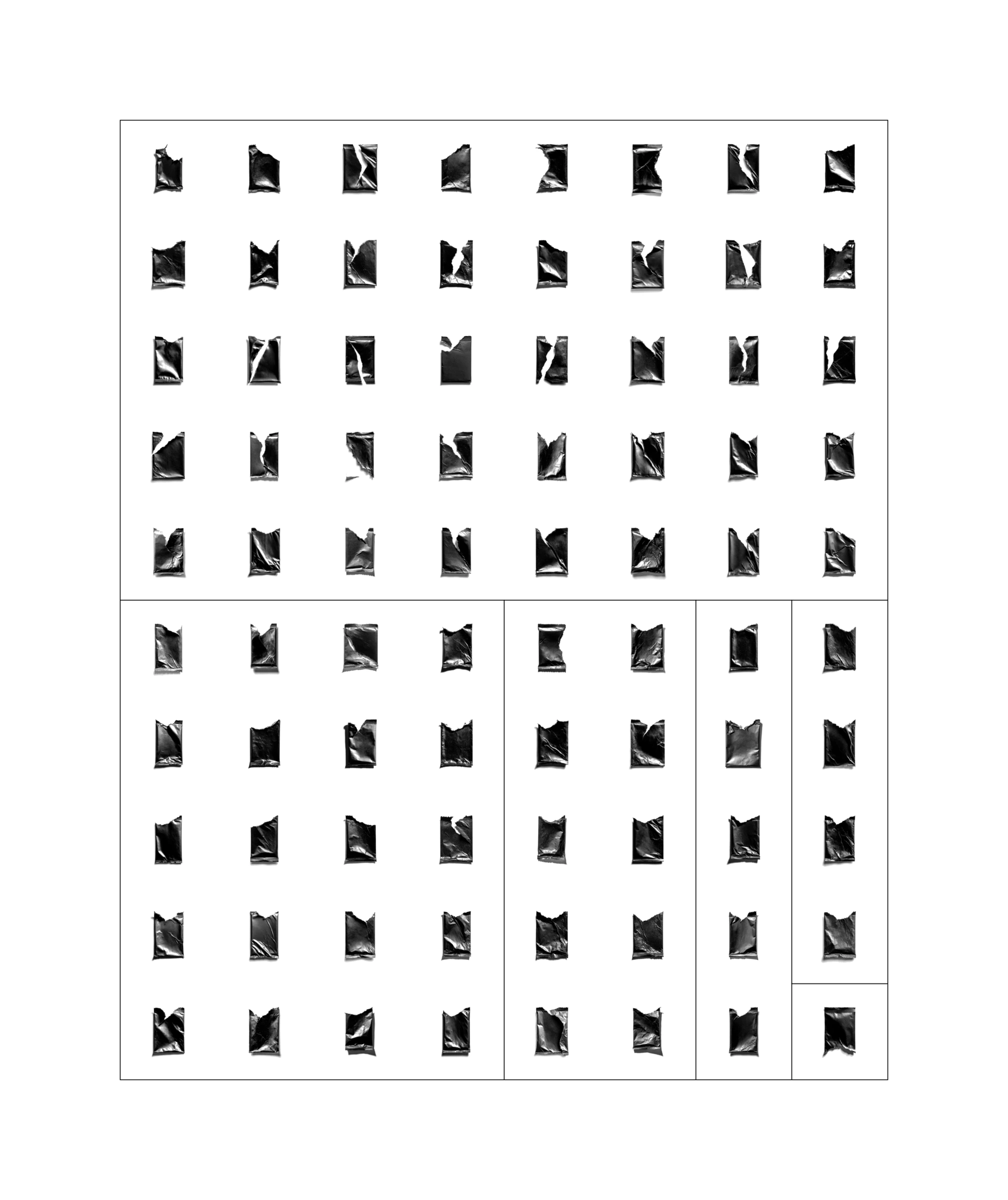
Wrappers is 80 generated images of torn trading-card packs. Each one is a black foil pack on a white background, ripped open, with the cards already gone. We measured how much light shows through each tear and ranked the images by it. The ranking falls into six groups of 1, 4, 5, 10, 20 and 40, named Euphoria, Complacency, Anxiety, Denial, Panic and Capitulation.
Collectors received them through a blind draw on Fake World Assets. Getting one meant opening a pack to find a picture of an opened pack.
Dalia Judovitz's Unpacking Duchamp: Art in Transit starts from the Box in a Valise, Duchamp's portable museum of his own work in miniature reproduction. She reads reproduction as the way he redefined the art object, and she says the spectator "completes, as it were, the creative process not as a passive consumer but as an active interpreter." Her fourth chapter, "Art and Economics: From the Urinal to the Bank", follows the same idea into money. Duchamp, she writes, rethinks artistic value as a function of its economic and social currency. His checks and bonds mimic currency and exchange, and in doing so undermine both artistic and monetary standards.
The precedent I keep coming back to is With Hidden Noise, from 1916. It is a ball of twine clamped between two brass plates. Walter Arensberg put a small object inside it before it was finished and never told Duchamp what it was. In a 1956 interview Duchamp said he would never know whether it was a diamond or a coin.
Whoever buys a thing like that pays for a secret, and the secret holds up because nobody can open it.
In Wrappers the prize is gone before you look. The tear is open and the only measurement left is how much light gets through. Euphoria, a single image, is the least torn pack in the set. The groups reuse the six-tier structure of Opepen.
Here the pack is the whole object, and it still gets ranked, grouped and named after a market mood. I don't have a clean answer for what that ranking is worth when the thing it was protecting has been taken out on purpose. Judovitz's chapter on art and economics is where I would start.
Work: Wrappers
Sources
- Wrappers, jack.art
- Dalia Judovitz, Unpacking Duchamp: Art in Transit, University of California Press, 1995. Introduction and chapter 4, "Art and Economics: From the Urinal to the Bank"
- Marcel Duchamp, With Hidden Noise, 1916, Philadelphia Museum of Art
- With Hidden Noise, Tout-Fait: The Marcel Duchamp Studies Online Journal, quoting Duchamp's 1956 interview