Notes /
VV Rare
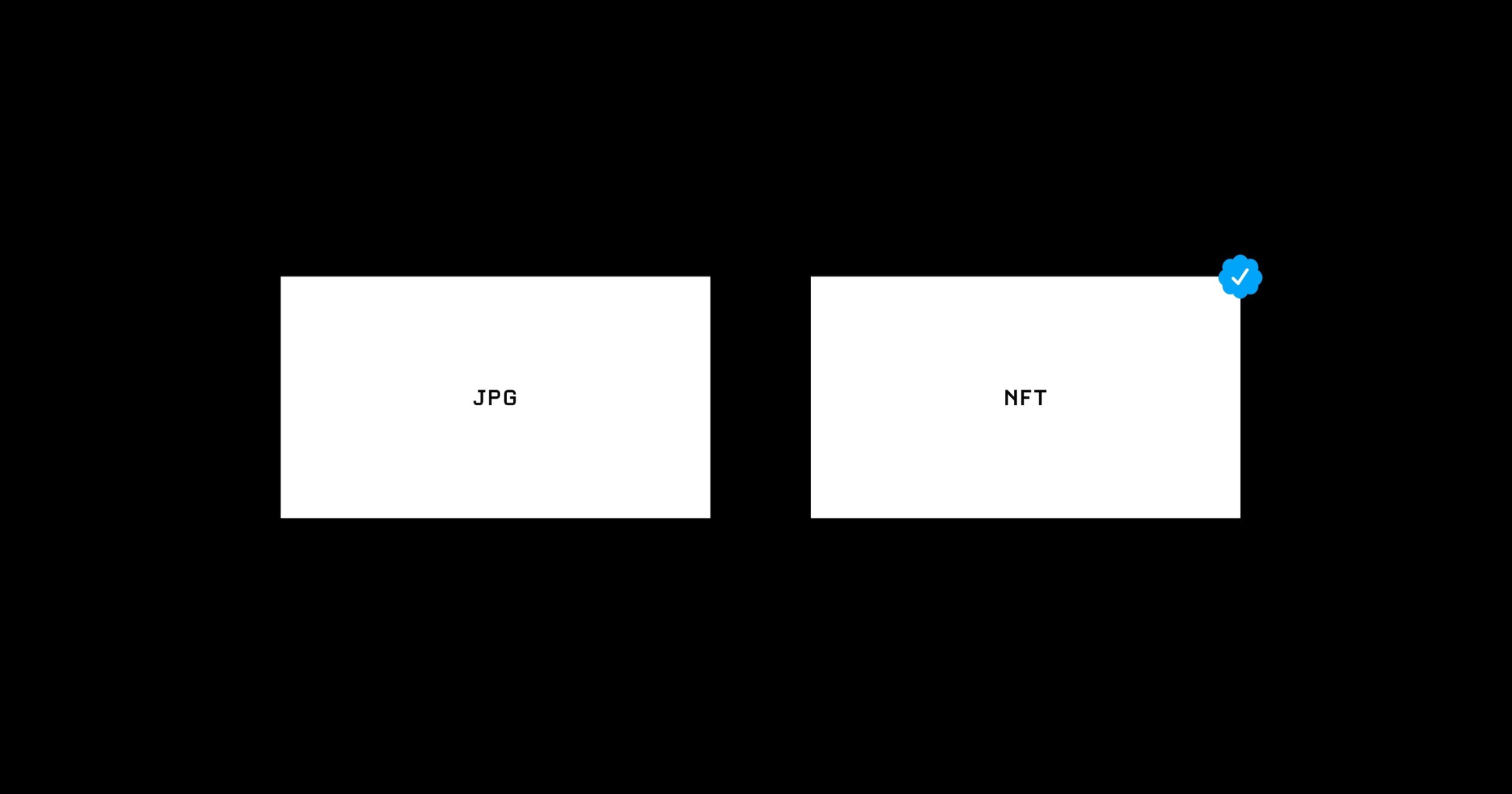
VV Rare is a set of unique works on Ethereum. I started releasing them through Foundation in March 2021. Each one is a single black-and-white proposition in the Visualize Value language, issued once. The image at the top of the page is two white rectangles on black. One says JPG. The other says NFT and has a blue check on its corner. Otherwise they are the same picture.
One of the earliest pieces in the series is called NFTs, explained. It is a diagram of the thing it was made with. In January 2023 I wrote that it "contains the genesis" of Checks, and that since then I had been exploring "the overlap between social contracts, NFTs, digital provenance, what art is, how it evolves, and who decides all of the above."
In Languages of Art, first published in 1968, Nelson Goodman takes up a question that sounds like it belongs to forgers and auction houses. Why does a perfect copy of a painting not count as the painting? His answer splits the arts in two. A work is autographic, he says, "if and only if the distinction between original and forgery of it is significant; or better, if and only if even the most exact duplication of it does not thereby count as genuine."
Painting is autographic. So is etching, even though a plate pulls many prints, because what counts is whether a print came from that plate. Music is allographic. A performance from a fresh copy of the score is still Beethoven's Fifth, since the score fixes what the work is and the history of the paper doesn't matter. Alessandro Giovannelli's summary in the Stanford Encyclopedia puts the hinge plainly: it depends on whether "a work's history of production is integral to the work or not."
A file sits in an odd place on that map. The JPG behaves like a score. Every copy is exact. Nothing about a given copy tells you where it came from, and no one would call a downloaded copy a forgery. By Goodman's test the image alone is allographic. There is nothing to fake.
The token adds the missing part. It is a history of production you can look up. It says which address issued this, when, and where it has gone since. That doesn't change a single pixel, and it doesn't stop anyone copying the picture. What it does is make the distinction between the one and the copies significant again, which is exactly the condition Goodman used to define the autographic arts.
That is why the two rectangles in the image are the same size and the same white. The difference between them isn't visible in the picture. It is in the record, and the check is only a sign pointing at it.
Giovannelli notes that on Goodman's terms, etching shows an art can be multiple and still autographic. VV Rare runs the other way. Each work exists once, while its image is as easy to copy as any other picture online. The uniqueness never covered the image. It covers the line back to the hand that issued it.
Work: VV Rare