Notes /
Full Set
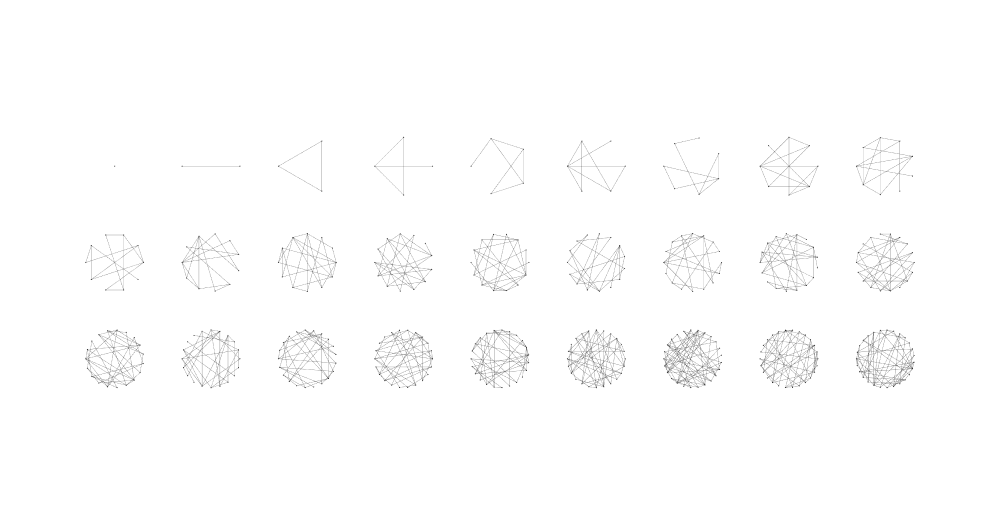
Full Set is 27 editioned images in a three-by-nine grid, released with Rodeo in 2025. After the first 26 were out, I found the tokens could be pointed at new pictures. So I replaced all 26 with a single network grid and attached a condition to the twenty-seventh.
If token 27 sold more than 159,300 editions, the combined count of the first 26, the grid would stay. If it didn't, the old images would come back. The rule ran in both directions. It could finish the work or undo it.
Claire Bishop wrote "Antagonism and Relational Aesthetics" in 2004 as a critique of Nicolas Bourriaud and the art he championed in the 1990s, mainly Rirkrit Tiravanija and Liam Gillick. Bourriaud said those works produced human relations, and that this made them democratic. Bishop asked the obvious follow-up. If relational art produces human relations, "what types of relations are being produced, for whom, and why?"
Her complaint about the Tiravanija meals is that nothing in them pushes back. There is talk, but there is "no inherent friction," because the situation "produces a community whose members identify with each other, because they have something in common." Everyone in the room already agreed to be there.
She has a sharper line about Gillick's pinboards, which were praised as democratic in structure. Only the people who own them can rearrange them. Participation turns out to be a property right.
Full Set takes that line and flips it. Holding one of the first 26 gave you no say at all over what your token showed. The decision sat with strangers buying a different token, each for their own reasons. Some of them probably wanted the grid. Some probably just wanted token 27. A purchase that looked private added to a total that changed something other people owned.
That is the friction Bishop says the dinner party lacks. The holders and the buyers were not a community that identified with each other. Most never met and never had to. The outcome landed on people who hadn't agreed to it and couldn't vote against it except by buying the very thing that pushed it forward.
Bishop leans on Ernesto Laclau and Chantal Mouffe here. A working democracy, in their account, is not one where antagonism has gone away. It is one where the frontiers keep getting drawn and argued over. I didn't set out to illustrate a theory of democracy. I set out to see whether a group outcome could be made out of separate private purchases. But the structure has the shape she describes. The boundary between those who decide and those who live with it is the work.
The studio catalogue later reported that the threshold was passed. The grid is what the holders have now. I still wonder how many of the people who bought token 27 knew they were voting on someone else's picture.
Work: Full Set